Would you like to write for us? We are looking for people with a passion for health, green solutions,
and environmental issues that need awareness. If you are interested,
please email us SanusSomes2010@gmail.com.
Showing posts with label exercise. Show all posts

Saturday, October 22, 2011

What Stage Are You At?


There are 5 stages a person goes through before starting a healthy routine.  If you are having a problem sticking to a routine, learning the 5 stages and identifying where you are may make it easier for you start and stick to a healthier lifestyle.

Somethings gotta change!!
First Stage: Pre Contemplation
At this stage you don’t think there is a need to eat healthier and exercise.  You think everything is fine and you can continue a life of scarfing down junk food and practicing the art of being a couch potato.  You shrug off claims that diet and exercise are good for you and decide to spend you free time in front of the television.

Second Stage: Contemplation
You realize you need to do something. Your weight has gotten progressively worse, and you don’t have any energy. You may be experiencing some health issues and you feel tired most of the time. When you check your kitchen for something healthy to eat, you find the closest thing you have for healthy consumption is water. Still the problem seems too big to handle and you decide to do nothing.

Third Stage: Preparation
In this stage you start collecting information. You call a few gyms for pricing and inquire about healthy eating programs. You may even engage in some sporadic exercise like walking once every week or so. People in this stage are ready to adopt a healthy lifestyle. This is the stage most get stuck in. If you can stay on this path and try to progress to the next stage it will be a big and important hurdle. Starting a routine with a friend is more fun. It’s much easier when you are not going it alone.

Fourth Stage: Action
This is the stage when people engage in a regular routine of healthier living. They exercise several times a week and make healthier food choices. This stage is still new and the routine has not been regular for more than 6 months. It is at this stage that more than half of the people give up and slide back to their old ways. If you can push through at least 6 months it is more likely to become part of your regular routine.  Your body will really show signs of a healthier lifestyle. Having a friend helps a lot in this stage. Sharing experiences, hardships and triumphs with someone else increases the rate of success.

Fifth Stage: Maintenance
By now the body has a routine and eating healthy is something that comes much easier. This happens after 6 months of a daily healthy routine. Regular exercise is craved by the body and you don’t feel right unless you stick to it. Health has improved, energy levels are up and you not only feel better but look better too!


We wish everyone good luck in starting their routine. But it is not luck you need. Your limits are defined by agreements you've made about what’s possible, change that agreement and you can dissolve all limits*. Remember you are never too old, too fat, too out of shape, too weak or too busy to start living a healthy lifestyle, only too lazy!!!


*Dr. Wayne W. Dyer, "Everyday Wisdom"

Written by Joann Agoglia
Edited by Rob Marshall

Thursday, August 25, 2011

What the Squat?

The squat is a very practical exercise. We do it during our everyday lives several times a day in one form or another. We all do variations of a squat when we get in and out of a bed, a chair, or a car. This movement is also the cause of a lot of back injuries because it is commonly performed incorrectly.

If you can get up from a chair, even if you need assistance getting up, you can do a squat.
If you need help of any kind getting up and sitting down in a chair, then the squat is the exercise for you. Like most exercises, the squat can be modified so that anyone of any fitness level can perform and benefit from it it.

The basic squat:
• Start in a standing position.
• Put a chair behind you. If you normally need assistance getting in and out of a chair make sure there is a sturdy table in front of you.
• Feet should be hips or shoulders width apart.
• Your weight should be in your heels. If you find this hard to do lift your toes (just your toes) up.
• If you don’t need assistance put your arms straight out in front of you or cross them in front of you with hands on opposite shoulders. If you need assistance put your hands on the table.
• Bend your knees and push your butt back towards the chair.
• Your knees should be over your ankle and should not go past your toes.
• Slowly lower yourself down into the chair
• Coming up is the same as going down (only in reverse).
• Feet and knees hips or shoulders width apart.
• Weight in your heels, toes lifted if needed.
• Lean your shoulders forwards slightly.
• Press weight down into your heels.
• Slowly straighten you knees by lifting your butt up and pushing your hips forward.

Once this becomes easy you can do the squat in a lower chair or bench. The next progression would be to do it without a chair or bench. After that you can start adding weight. Start by holding a 5lb weight in each hand. Let your arms hang at your side. Remember this is just to add weight to your body so your arms should not move, keep them as still as possible.

This is just one way to start and progress this exercise. As always if your are unsure about this or any exercise you should consult a professional. We are always happy to answer any questions you may have. Happy squatting.


Written by Joann Agoglia
Edited by Rob Marshall

Thursday, August 18, 2011

Are you long and hard or short and stiff?


There are three key elements to a well rounded workout: cardio, strength training and stretching.  Cardio is probably the most popular.  When most people think of getting fit they turn to some sort of cardio exercise. They begin a running or walking routine, join a class and do kickboxing, dancing, or boot camp. But cardio is only 1/3 of a successful exercise routine. Strength training and stretching are important for the health of your muscles. You need both of these added to cardio to execute a good workout.

Strength training needs stretching. Typically men have no problem strength training but are reluctant to stretch. I have been told it is because they feel that it takes away for the bulk they have tried so hard to build up during training.  Women on the other hand are reluctant to strength train because they do not want to bulk up. They are more likely to take a yoga class then to start strength training. In one of my previous blogs I wrote about how important it is to strength train. This time I feel the need to talk about stretching. So many people not only don’t stretch but don’t know how to stretch.

Without stretching, your muscles become short, stiff, and brittle. Joints become very limited in movement and start to ache. No one wants to workout when they are feeling achy. When you add stretching to your routine your range of motion (ROM) gets bigger.  Your joints are not as stiff, which reduces soreness. This also helps prevent injury during your workout and in everyday activities. When your muscles and joints are flexible you can move about more freely. A wider ROM is important to weight lifting, as well. You use more muscle fibers when you expand your range, and when you use those fibers, they make the muscles stronger. Stretching also makes the fibers longer and gives you iron pumping hard bodies more room for bigger muscles.

Stretching also helps improve circulation, decrease muscles tension and improve your body and mind’s ability to relax. Poor posture often comes from the chest muscles being too tight.  Just think of gravity pushing down on us all day, putting pressure on our shoulders.  After a while, the shoulders start to slump forward and create weak back muscles and short, tight chest muscles. Stretching those muscles out can improve your posture and reduce back pain.

Stretching is a very natural thing.  If you have a dog or cat, watch them after they wake up.  The first thing they do is stretch.  Where do you think the yoga poses "downward dog" and "cat stretch" come from?  My dog actually stretches before she plays her favorite game of fetch with my son.

Like everything else in fitness, performing a stretch has to be done correctly and safely to be effective.  If you have any questions on how to stretch properly you should consult a professional.  We are always more than happy to answer any questions you have.


Written by Joann Agoglia
Edited by Robert Marshall

Friday, August 12, 2011

A Dose of Reality
Mac and Cheese: The Other White Meat

A long time friend of mine had a Facebook post this week that drew a lot response. Normally this is no big deal. His posts are pretty popular. The first few words “Colin” and “school” caught my eye. I thought it was another charmingly funny post about his son Colin. I, not unlike many others, love to hear about his grade school experiences. My favorite being the picture of his butt he drew in school that the teacher didn't quite appreciate. Anyway, this time it was a note about the upcoming school year. According to Sean it read, “In order to comply with state and district nutrition policies we no longer permit celebratory snacks for birthdays or class parties.” Almost immediately the comments stated pouring in. They all had the same tone. People stated how fed up they were with the state and government stepping in to fix a problem with the wrong solution. I have to admit my views are not much different.

I remember back in the day celebrating birthdays and holidays in school. I would bring less for lunch on those days because I knew I would be eating all the yummy cookies and cakes the moms brought in. I also remember going outside for recess and running till I couldn’t run anymore. Today, recess is much more structured. Some schools feel it is necessary to organize play time in order to get all of the children moving. It is true that kids don’t get out and play enough because television and Xbox keep them occupied most of the time. Let’s face it. It is not just the kids that are occupied by the flat screens. So are the adults. The truth is we all need to move more. We all need to spend more time away from our computers, TVs, and video games, but that is only part of the problem.

We get angered when the state imposes rules on us especially when it regards our children. When it comes to kids’ health, there is no one in the world that has a child’s best interests in mind more than the parent, and we don’t need the government to step in to force rules on us. The politicians need to learn how to do their own jobs before they start telling us how to do ours. So when the school district sent that letter home regarding celebratory snack food, I felt that the government was fringing upon our rights once again.  But before I started to bash this policy, I needed to see just what the states position on nutrition was.

This is protein according to the USDA.
Reading the USDA’s policy on the school lunch and breakfast program is very taxing. It is 78 pages long, and it covers not only the dietary requirements as defined by the USDA but the cost of EVERYTHING, which is understandable. As I read past the first 10 pages, I kept thinking that nutrition doesn’t have to be this hard. Then I realized this is the government and everything really does have to be this hard. Everything needs to be worded so that maybe, just maybe, you will get tired of reading (as I did), and just give in (which I didn’t). I started to sift through the crap looking for what the USDA thought was nutritionally sound food. A few things caught my attention. I was reading the daily recommendations of fruits, vegetables, whole grains, meat and meat alternatives, fluid milk, calories, and saturated fat from calories, sodium, and trans fats. It all sounded good. Then I got to the definitions of whole grains and fruits. A whole grain was defined as whole grain rich.  It said nothing about being 100% whole grain or made with 100% whole grain flour. If you have not read our blog on White Bread vs Wheat Bread, you may find it interesting to know that if a product only says whole grain, it may as well be made with white flour.  In turn, whole grains can equal a lot less nutrients and empty calories. The same concept applies when they talk about enriched macaroni as a substitute for protein. Yes, you read that right. Enriched pasta can be used as a source of protein. But its white pasta we are taking about here, and it goes through the same process as white bread because it is made with white flour. Then they put nutrients back in to make up for what they took out. Doesn't make much sense does it? It just equals more empty calories. Then we come to the fruit requirements. Fruit doesn't always have to be fruit.  Fifty percent of the daily requirement can be in juice form. We also did a blog on that. Once you remove the juice from the rest of the fruit, you remove the sugar from the nutrients that help your body digest, utilize, and properly dispose of the sugar. This is why a diabetic can drink orange juice or eat a piece of candy when they are low in sugar. It is absorbed quickly into the blood stream. There was no mention of water intake. We did a blog on that too! Water is one of the basic things the body needs yet not one word about it in any of the 78 pages.

It seems like a good portion of the requirements are based on calories. Americans have been counting calories for at least 50 years and we have gotten fatter every since. If you go by this standard some of the healthiest breakfasts would not stand up to these requirements, but some of the crappiest breakfasts would pass. Example: the following breakfast would not be enough caloric intake even for a kindergartener

1extra large egg
2 pieces of whole wheat toast
8 oz glass of milk
15 grapes
Total 340 calories

If you take this same meal and substitute the nutrient rich whole wheat bread for the empty calories in white bread and add 1 slice of bacon (assume this could count as protein even though it is the fat of a pig) then maybe it would an acceptable breakfast for K-5. My kids would never have eaten this much for breakfast at that age. Then, we would have to add another 100 calories for the grades 6-8 and another 200 for the high school kids.

Then of course we come to the center of all the FB comments: the state’s policy on foods with minimal nutritional value. It is called Title 7. You can read the whole thing on our FB page. From what I can figure out chocolate is still ok if it doesn’t contain corn syrup. I find that strange because a lot of enriched foods like bread have corn syrup in them.  Soda is a no go but not because it contains loads of sugar but because of the carbon dioxide. Water ice is not expectable unless it contains fruit juice (I believe we covered the whole fruit juice thing) or real fruit. So I don’t know how Rita’s was allowed into the school lunch room last year.

I could sift through this policy for hours and find more problems with it, but the bottom line is that the state doesn’t need to tell us how to feed our kids. The government loves to put band-aids over bleeding wounds. The reason the government changed the policy on the school lunch programs is because they wanted to make fruits and vegetables more available in school meals and to help fight the obesity problem that plagues America. So they make it appear like they care by imposing regulations on schools (who are already stretched by budget cutbacks) about what they can or cannot serve and what parents can or cannot bring in to the classroom. Meanwhile big business gets to brainwash our kids by constantly bombarding them with ads and images everywhere you look.  It’s not just enough to limit the TV and computer time. You would have to keep them isolated from them completely. How about a drive down the road just passing a fast food joint? You can’t escape the oversized advertisements. And forget about taking them to the super market. The focus on kids is ridiculous with movie characters on the box, toys inside, chances to win computers or an Xbox, etc. Then they hit you with the 1/3 less sugar or no sugar added so you feel good about buying it. But what you may not know is that a favorite trick of the trade is to make the portion size smaller so the 1/3 less sugar refers to sugar per serving size and the no added sugar means they added a new kind of chemical sugar to keep the taste sweet. The snack food today is nothing like it was 20-30 years ago. The food today is grown from seeds that are genetically engineered with things that don’t have to be proven safe for human consumption. The meat that is served in fast food restaurant and big restaurant chains, even the meat we buy in the super markets, is loaded with hormones. It won’t say so on any food label or warning because the corporations responsible for this food don’t have to tell you if they inject their meat with hormones. The government agencies that are supposed to regulate what goes into our food are run by the same big business that make and grow the food. The same people who run corporations that grow genetically modified foods in this country are the same people who run government agencies like the FDA and the USDA. Each year they change jobs and bounce back and forth from the corporations to the government positions. It is like a game of musical chairs only no one is left standing. They all have a seat at a new job: different position; same crap.

So you are right, all you angry posts on Sean’s FB comment, the state should not be poking their nose in what we feed our kids.  We need to protect our children from the government. I urge everyone to become an avid label reader and find out what is really in that food you are feeding your family. It may take time, but it is time well spent. Nothing is more important than the health of your family. When things break, like your car or something in your house, they can be replaced or fixed. It may cost money, but it can be replaced. It is not so easy to replace good health. Once it is gone it can be very hard to retrieve. You may need the help of a professional. With all the pitfalls and food traps on the market today, it is understandable that the average person would need help with such an important issue. Let us know if you have any question. We are more than happy to offer our assistance!

Written by Joan Agoglia
Edited by Robert Marshall

Tuesday, August 9, 2011

A Shot of Fitness
Walk a mile in your own feet.


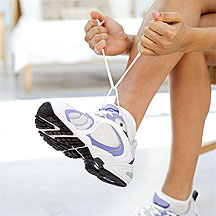
Nike, Converse, Reebok, ASICS, and ADIDAS. Shoes come in all different sizes, shapes, colors, styles, and prices. As we watch the evolution of the shoe, we can see that it has followed the same path as other products from the common sense to the gimmicky.

First there was the sandal. Then there was the leather shoe. And at last, the rubber sole. US Rubber (The big tire companies) created the first comfortable sneaker in 1892 called Keds. Keds were mass produced in the early 1900s and were soon manufactured for basketball players by Converse. If you know your shoe history, you probably know that Chuck Taylor began endorsing Converse shoes in 1923 which are now lovingly called "Chuck Taylors" or "Chucks" by millions of devoted shoe fans. Soon a German man named Adolf "Adi" Dassler took shoes to the global market creating his own brand called ADIDAS (cleverly named after himself). His brother Rudi started Puma (one of my personal favorites). In the 50s, sneakers became fashionable with movies like Rebel without a Cause. Fast forward to 1984 and the first batch of Air Jordans, and the modern colorful, laceless, air-pumped, zig-zagged, butt-lifting sneaker generation begins. Competition becomes so intense that shoe manufacturers have to find the next best thing to make a buck. This competition created the running shoe and the monsters that spawned from it.

The next big thing. It's American, is it not? HDTV, Xbox 360; SUVs with HDTVs and Xbox 360s. This approach exists throughout all corners of our markets, but sometimes one has to stop and wonder if the next big thing is right for them. Shoes are one of those big things. Historically, humans have lived centuries without compression gel in their soles, zig-zags under their heels, or ridiculous gimmicks pumping them up. The basics of footwear were to protect the foot from damage from sharp objects or hot or cold surfaces. But for the sake of money, shoes keep evolving. The modern shoe company has created running shoes that let the human body open its stride, land stiff-legged, and drop its entire weight on fragile hip, knee, and ankle joints without feeling the immediate consequence of pain it would get from performing the same action barefoot. Today's shoe has become a cast. Look inside of your shoe right now and see what's inside. Go ahead. I'll wait. Hey, have you seen the Walking Dead? Pretty cool, right? Yeah, I know! Zombies are awesome. It was about time we got some good zombie TV shows going on. Oh, you're done checking? What did you see? Some cushioning material, maybe the name of the shoe company, perhaps some cool interior designing going on, and what else? Did you see your arch support? I bet you did.

You may or may not have worn a cast before, but chances are that you know someone who has. After a few months, the doctor takes it off, and you finally get a good look at the limb (in this case, let's say an arm) that's been locked away 24/7. When you compare it to the other arm you can see a big difference. Ol' cast-y arm has atrophied! It's weaker and in need of some TLC. Let's imagine for a moment that you put a cast on your arm every day for 16 hours at a time, and you have done this since you picked up your first toy as a child. Now you wear it when you try to play sports, make lunch, or do school work. Kind of a pain in the butt, right?


Now imagine that your arm is your foot. Not only that, but the folks that sell you casts keep telling you that the next big cast is even better because its blue or green or black, and it pumps up to get tighter. And now you can run in your cast without feeling it for a few years (but you still get a nagging pain in your lower back for some reason). That cast is your running shoe. The arch "support" puts pressure underneath your arch. "So what? That's supposed to be good for your feet." The way an arch (architecturally) stays up is with downward force (gravity) pressing evenly on all pieces. If pressure is placed upward, the arch can collapse (or in the case, atrophy) making it not "good for your feet."

What is the alternative? My personal preference is to go barefoot whenever possible. The bottom of the foot is full of nerves for a reason. That reason is to send information back to the brain about the environment. When that information is processed, the body (naturally in pre-cast times, methodically in the modern era) changes the gait so that it can walk or run as safely and efficiently as possible to protect the joints. A person with their shoes on my impact the ground at 300% of their body weight on one leg when running. A person going barefoot will soon find out how not to impact that way. That is done when the knee bends and the person lands on the ball of the foot (not the heel) to absorb the weight of the body like a car's suspension. It is a skill to walk and especially run in that fashion, but it is not impossible to learn. The other alternative is to find shoes with little to no arch support. Chucks are usually pretty good with that. Right now my favorite shoes are a pair of Toms. The only problem with them is there is just a little too much support, but the balance is that they are easy to slip on and off so that I can go barefoot any time.

“But what about orthotics?” some of you may say. There may be some cases where orthotics are helpful like with pronated feet, but if you do not have pronated feet or feel foot pain then chances are that you do not need arch support. Of course, you should refer to your doctor about that. If your doctor says that you need support, remember to ask why and ask for alternatives. Doctors are not immune to marketing or gifting (did you know that they get all types of free stuff from pharmaceutical companies like clipboards, food, and vacations?) so be confident and know your options.


Not sure what to think about your shoes? Time to do some research, my friend. Read about the Tarahumara. They are a tribe of people that run for the sake of running (sometimes marathon long runs), and they do it barefoot. The Tarahumaras are interesting people. Some of their elite runners have won extreme marathons in the States wearing nothing more than tire rubber tied to their feet (for protection).


Take some extra time today to set your feet free, and remember what it is like to feel (the ground). Its only natural.
Written by Robert Marshall

Thursday, July 28, 2011

A Shot of Fitness
Anyone Can Push-up "Easy Peasy"

With so many fitness trends on the market it is hard to know what to follow. They all claim to help you lose weight and get the body you've always wanted. There are DVDs to watch, machines to figure out, diet plans to follow with calories to count and special foods to eat. All too soon you grow tired of it all and go on to the next greatest weight loss scheme or exercise equipment in hopes to get that body you've always wanted.

 There is a piece of fitness equipment for just about every exercise. They all claim to help you perform an exercise safely and effectively. What they don’t tell you is that you don't need to spend your money on the latest fitness gadget. The simple act of learning how to perform an exercise safely and effectively will promote muscle balance in your body.

Your body can move around because your muscles work together to stand up, sit down, walk, go up and down stairs, and do all sorts of other things. Muscles working in unison is natural. Athletes often need to work one muscle group more than another because of the role those muscles play in their job. For instance hockey players may want over developed upper leg muscles because their sport requires this muscle group to be working at all times. For the non athlete this is not necessary and basic exercises are all that you really need. Of course you may get bored of the basics, but variations of basic movements can also get the job done.

Let's take the push up, for instance. The other day I saw some contraption on tv that was supposed to help you do a push up. It supported your chest, and all you had to do was push down with your arms. Someone who cannot perform a push up may think this is a perfect way for them to learn how. But a cheaper more effective way of doing a proper push up is to do a series of modified push ups. Each of these modifications will bring you a step closer to doing a full push up. Enclosed are some pictures to help you get the idea.

There are a few ways to do a good push up and many ways to do a bad one.  I will give you an example of a good push up. Before you begin lets go over the important parts of a push up. Keep your body straight making a long line from the top of your head to your heels.  Your hands should be shoulders width apart and feet about 4 inches apart. Slowly move your body forward by bending the elbows. Keep a tight stomach, inhale on your way forward and exhale on your way back. When you are comfortable doing 10 repetitions with one form, you may move on to the next.

Start with a push up against the wall.  If you have trouble with your wrists (carpel tunnel syndrome) you can make a fist and put your knuckles on the wall.
The nest step would be to find more of an angle.  A table , counter or bar like this will do
Keep finding a lower surface.  A chair would also work.
When your body gets strong enough, move to the floor on your knees.
This is the final step.  Your form should look similar to the first picture. The exception being that you are on the floor.  
If there is an exercise that you have difficulty performing or one that you just can't do let us know.  We can come up with a series of modifications to help you.

Written by Joann Agoglia
Edited by Robert Marshall

Friday, July 15, 2011

A Shot of Fitness
Starting a Routine

How many times have you been to the gym and have seen some pretty big people pounding it out on the treadmill? Many people know that running with poor form can damage the cartilage in the knees. Knowing that, why would these people continue? A lack of understanding is the biggest contributing factor.

When you start a routine, you need to evaluate yourself first. Are you overweight? Do you have any strength training or cardio experience? Do you have any injuries or health problems? These are all questions you should ask yourself before you step into a routine. The next question should be, “What are my goals, and how will I achieve them?” It’s time to consult a professional if you aren't sure.

Strength training is a great way to start out a routine, but, like anything else, it will take time and some learning to understand how to perform the exercises correctly. If you lift improperly, you will increase your chances of getting injured. My best advice is this: do not start lifting without help from someone that has experience. Learning from a personal trainer or other professional will give you a good foundation. The muscle that is developed during strength training will help consume more calories and support bone structure.

In addition to strength training, you will want to learn how to properly stretch. Notice the word “properly.” Stretching is about relaxing and elongating the muscles that are shortened during regular use, and, just like lifting, it takes time and understanding to perform a stretch correctly. You might be able to learn some stretching techniques from a book, but you may learn more from a yoga instructor or from a personal trainer (one that actually stretches!).

When beginning a cardio routine, begin with low impact exercise. This can include ellipticals and bikes. If you are intent on using a treadmill, you can set the incline above 45 degrees to reduce the impact on your joints.  Another tip for a beginner is that you should just still be able to speak while you are working out. That is only a tip and should not be considered the only way to do cardio. There are a lot of opinions on what cardio should look like. Do your research and find what works for you. A big priority for cardio should be your heart since cardiovascular exercise will strengthen it.

Those are three aspects of physical fitness. However, they are not the complete picture. Remember that nutrition is an enormous part of fitness. Two people that exercise the same will get different results if one eats well and the other eats poorly (consider our previous articles to see our understanding of good and poor nutrition).

If you have questions or comments, please let us know! We will be glad to answer you.


Written by Robert Marshall
Edited by Joann Agoglia

Monday, July 11, 2011

Women and Weight Loss: The Heavier, the Better

We have trained many different people of all ages with different body types and fitness levels.  Each one is as unique as the next, yet almost all of the women seem to share one common concern. This concern always pops up at the same time during their training. The second they lay their eyes on ten pound dumbbells we hear, “I don’t want to lift heavy weights! I don’t want to look like a body builder,” or “I don’t want big, bulky muscles.” Many clients do not understand that big weights do not equal big muscles despite constant reminders that I lift heavier weights and by no means would be considered bulky. Any trainer will tell you that if a person’s head isn’t committed to what they are doing, they will not be able to perform. This is especially true for women trying to lose weight. So listen up all you women who refuse to lift anything more than 5 pounds or do nothing but cardio workouts hoping to lose weight that never seems to come off.  Here is the truth about lifting those heavy weights.


Let’s start with the reason why heavier weights will not “Pump You Up.”  It is the lack of hormones and body structure that makes most women genetically unable to produce large muscles.  Testosterone is the hormone that helps bulk up.  Women have 15-20 times less testosterone than men.  This hormone is what makes it easy for men to gain muscle so quickly.  Unfortunately, it is the abuse of this hormone that produces abnormally large muscles on men and women.  So if your trainer isn’t slipping you anything in you water or injecting you with something, bulking up should not be a concern.


Now let’s talk about the many reasons why women need weight training.  I haven’t looked at any research numbers or Googled any studies, but I am willing to bet that the number one reason why women start a fitness routine is to lose weight.  There are, however, studies that support me when I say women typically stick to cardio exercise in an attempt to lose weight.  This would explain why the treadmills are always filled up at the gym, and the fast paced cardio step/dance classes are always packed.  The need to lose weight is also the reason why diet pills and so called “healthy eating plans” have become a billion dollar industry. Ahh, how great would it be if all you had to do to lose weight and keep it off was to take a pill or eat prepared meals all day?  But as many of you already know from experience, this doesn’t work, and cardio exercise alone will not be able to give you that trimmed, toned body you want.  As a matter of fact, low calorie diets cause your metabolism to slow down, causing your body to go into starvation mode.  Now add in cardio exercise. Where is your body going to get its energy from?  When your body is given a choice of using fat or muscle for energy, it chooses muscle.  Wouldn’t you?  Just think if you were given the choice of eating a bowl of fat or some lean chicken.  Most of us would pick the meat every time, and so would your body.  Strength training builds stronger connective tissue and increases stability in the joints.  The risk of injury is greatly decreased when joints are stronger and more stable. This makes it safer for you to attend that fast paced cardio class or go for 45 minutes on a treadmill.  By the way, strength training doesn’t take up much of your time. 20 minutes, 2-3 times a week can do the trick.  With a good personal trainer, cardio and strength training can be combined.  Imagine no more 45-60 minute workouts.


Another reason for strength training is increased strength.  The key word here is strength.  Increased strength does not mean large muscles.  Why is it so important?  There are several reasons why strength is vital to your health.  Let’s go over the obvious reasons first.  Muscles need to be strong to support your frame (your skeleton). “But this still doesn’t explain why we need heavier weight,” you may say.  The stronger your muscles, the easier it is to do your daily activities. You daily chores should not push your strength to the limit.  Lifting groceries, laundry, kids, or anything that involves pushing, pulling, and lifting can be potentially dangerous.  If your muscles are strong, you are less likely to have an injury.  Anyone throw their back out lately doing any of those things?

Bone density increases with weight training.  The support the muscles give the bones is critical.  Research shows that weight training can increase bone spinal mineral and enhance bone modeling.  In other words strength training reduces your risk of Osteoporosis.

One of the best reasons for weight training is that it helps you burn fat even when you are not doing anything at all.  Lean muscle increases the rate of resting metabolism; you can burn more fat even when you are sleeping!  For every pound of muscle you gain, you burn 35-50 more calories every day!  Strength train more if you want to lose weight and keep it off; don’t eat less.

Now it is not just about moving heavier weights. It is about knowing how and when to lift heavier weights.  Your muscles will not become stronger if they aren’t challenged, and it is important to work your muscles to fatigue.  It is also important to know how to lift weights.  Proper form is everything when you are weight training.  Without it, weight training can be a dangerous task.  Please seek out a knowledgeable professional. If you need help finding one, please let us know.


Written by Joann Agoglia
Edited by Robert Marshall

Wednesday, June 22, 2011

An Easy Way to Be More Active and Save Some Gas, Everyday

We all do it.  Comb the parking lot until we find the closest parking space. Getting a front row parking space is like winning a game of musical chairs, but what is the prize?  Sure if it is raining you don't get soaking wet, but do we really need that prime spot everyday?  We think nothing about spending a hour walking around the store or mall. Why not walk a little farther to your car?
 
    Roaming the parking lot is a waste of time and gas.  The traffic is worse the closer you get and people are everywhere.  It is much easier to park in those spaces that are always open.  This is a great idea if you are going out to eat because a walk after dinner is good for the digestion. If you go to a strip mall and have to go to several stores, park in a central location and walk to each store instead of moving the car around the parking lot.

   So leave those close parking spaces for the elderly and those who really need to park close (yes even at the Wawa).  If you have two working legs put them to work, save gas and enjoy the nice weather.

Written by Joann Agoglia
Edited by Robert Marshall